
The Jewish community in Sardis became even stronger during the rule of the Seleucid king Antiochus III the Great. He ruled from 223 to 187 BCE. Ancient sources say that he moved about 2,000 loyal Jewish families from Babylonia and Mesopotamia to the regions of Phrygia and Lydia in western Anatolia. He trusted these families and wanted to strengthen his control over these areas.
Since Sardis was the main centre of Seleucid administration in Lydia, it is very likely that some of these Jewish families were settled there. This would explain the early and strong presence of a Jewish community in the city. Over time, this community became wealthy and influential The Main Church of Sardis (Church D).
The Largest Known Ancient Synagogue
The synagogue in Sardis is the largest ancient synagogue discovered so far. This makes it one of the most important Jewish monuments from antiquity.
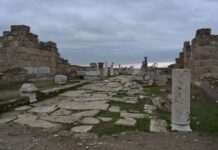
Archaeological excavations show that the building was not originally constructed as a synagogue. At first, it was a civic basilica. A basilica was a large public building used for meetings, trade, or legal matters. It was built between the main street of Sardis and the gymnasium. Later, sometime between 150 and 250 CE, the building was converted into a synagogue.
The very large size of the building and its rich decoration show that the Jewish community of Sardis was both wealthy and respected. Inscriptions found in the synagogue mention important titles held by members of the community. These titles suggest that Jews in Sardis had a high social position and were well integrated into city life Guided Tours Istanbul.
The Final Form of the Synagogue
In its final form, which dates to around 320–340 CE, the synagogue consisted of two main parts: a large colonnaded forecourt and a long assembly hall.
The Forecourt
The entrance area was a beautiful peristyle courtyard. This means it was surrounded by columns. The floor was paved with colorful mosaics made in geometric designs. Some mosaic panels contain inscriptions with the names of donors. For example, one inscription reads: “Aurelius Polyppos, pious, having made a vow, I fulfilled it.” These inscriptions show that members of the community gave money for the decoration of the synagogue.
The corner columns of the portico were heart-shaped and topped with Ionic capitals. The walls of the courtyard were first covered with plaster and later decorated with marble panels. It is believed that the courtyard may have had two storeys, matching the height of the main hall.
A low balustrade ran between the columns, separating the portico from the open courtyard. At the centre stood a marble fountain shaped like a large bowl or crater. This fountain may have been used for washing hands before prayer, which is an important Jewish tradition. However, it is also possible that it served as a public fountain, and the courtyard may have been used as a public meeting place.
The Main Assembly Hall
Beyond the forecourt was the long assembly hall, where members of the Jewish community gathered for prayer and study. The walls were decorated with marble revetments, giving the hall a rich and impressive appearance.
The size and beauty of the synagogue clearly show the importance of the Jewish community in Sardis. Located near the gymnasium and the main street, the synagogue stood at the heart of city life. Its remains today provide valuable evidence of the strong and respected Jewish presence in ancient Sardis.