Archaeologists have uncovered two important churches to the right of the path that leads to the famous Temple of Artemis in Sardis. These churches give us valuable information about the early Christian community in western Anatolia. They show how Christianity developed in this ancient city over several centuries.
The First Church (Church EA)
The older church, known as Church EA, was the larger of the two buildings. Experts believe that it was built in the middle of the fourth century. This makes it the oldest church discovered so far in western Anatolia. Its early date is very important because it shows that Christianity had already become well established in Sardis at that time Jewish Settlement under Antiochus III.
The large size of Church EA suggests that there was a strong and active Christian community in the city. In the fourth century, Christianity was spreading rapidly across the Roman Empire. The construction of such a large church indicates that many people in Sardis had converted to the new faith.
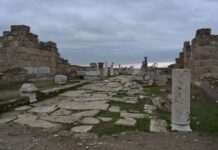
Although the church is now in a fragmentary condition, archaeologists have been able to understand its general plan. The building included a courtyard, a narthex (an entrance hall), and a nave with side aisles. This layout was common in early Christian basilicas. The eastern half of Church EA is currently hidden beneath the second church that was later built on the same site.
One important remaining feature is the curved foundation of its apse, which can still be seen on the eastern side. The apse was supported by strong buttresses. Unfortunately, the upper parts of the building, known as the superstructure, have not survived. Over time, the church experienced several changes and repairs, showing that it remained in use for many years.
The Second Church (Church E)
The second church, known as Church E, was built on the ruins of the first church. It was smaller in size and dates from the Lascarid period, which followed the Fourth Crusade and the division of Byzantine lands in the early thirteenth century Istanbul Private Tours.
Church E reused materials from the earlier building. This practice was common in medieval construction, as builders often recycled stones and other materials from older structures. The second church was built mainly on the eastern end of the previous church.
Like the earlier building, Church E had a narthex and a nave with side aisles. However, its apse was smaller than that of Church EA. One of its most interesting decorative features was the exterior wall design. The outer walls were decorated with friezes made of hollow quatrefoils. These were created by placing clay pipes vertically into the wall surface, forming a patterned design.
Today, the fallen dome of Church E can still be seen among the ruins. This remains one of the most visible and impressive parts of the structure.
Importance of the Discoveries
The ruins of these two churches, located near the great Temple of Artemis in Sardis, show the religious transformation of the city. Sardis was once famous for its pagan temple, but later it became home to a strong Christian community. The discovery of these churches helps historians understand how religious life changed over time in this important ancient city.
These remains stand as silent witnesses to the long and complex history of Christianity in western Anatolia.